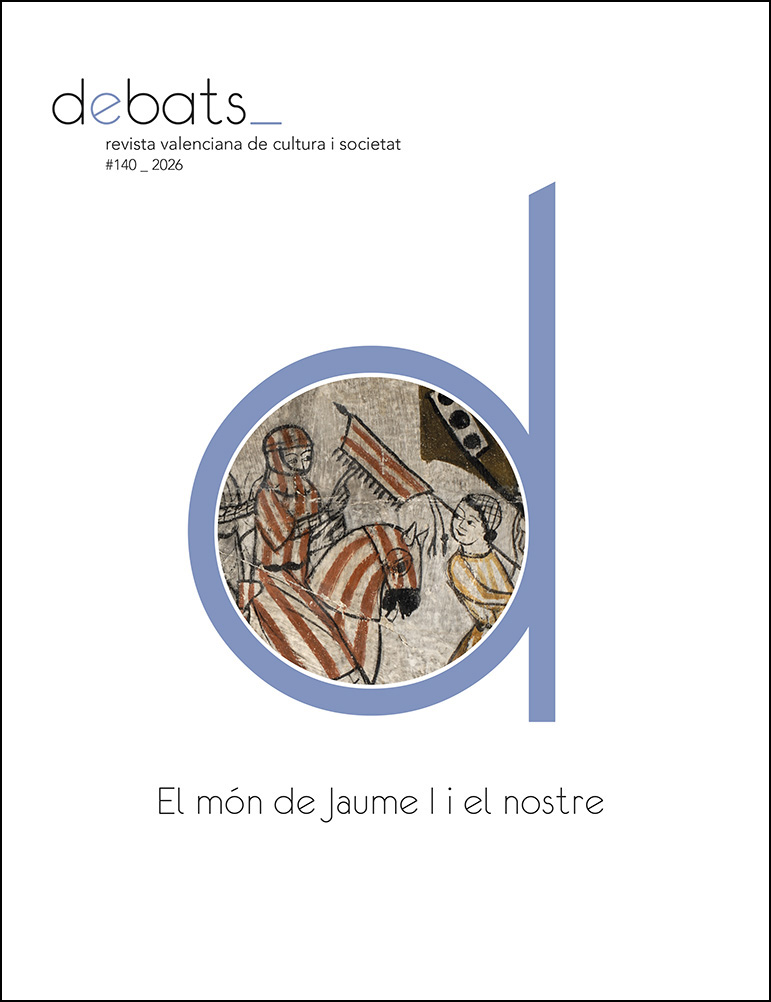
The symbolism of James I: from romantic myth to political figure
DOI:
https://doi.org/10.28939/iam.debats-140.9Keywords:
Identity, Valencian Country, founding miyth, symbolism, transition, multiculturalismAbstract
This text analyses the evolution of the symbolism of the figure of Jaume I in the Valencian Country, from its construction as a myth to its most recent political instrumentalisation. The aim is to understand how this historical figure has been reinterpreted over time by different ideologies and historical contexts, as well as the role he has played in the configuration of the Valencian identity.
Based on historiographical analysis and carrying out a review of the historical sources, academic studies and cultural and political manifestations that have contributed to the construction and re-signification of the myth of Jaume I, his role throughout history has been studied. The text examines the different stages, from the Middle Ages to the present day, placing special emphasis on key moments in the country's history such as the Renaixença, the Franco regime and the years following the dictatorship.
The results show that the figure of King Jaume I has been a highly flexible symbol, capable of adapting to diverse and often opposing narratives. It has been used both to reinforce a Valencian identity and to integrate itself into broader political projects, and has even been the subject of symbolic dispute between different ideological sectors. Likewise, more recent research has contributed to clarifying the traditional view, incorporating critical perspectives on the conquest and its consequences.
This research shows that the conquering king continues to be a central element in the Valencian collective imagination at the same time as it highlights the need to review this myth from a more plural and critical perspective that integrates all the historical dimensions of the process.
Downloads
References
Flor, Vicent (2009). L’anticatalanisme al País Valencià: identitat i reproducció social del discurs del «blaverisme» (tesi doctoral), Universitat de València.
Furió, Antoni (2007). El rei conqueridor: Jaume I entre la història i la llegenda, Ed. Bromera, Alzira.
Fuster, Joan (1994). Nosaltres, els valencians, Edicions 62, Barcelona.
Granell, Francesc (2022). «Commemorating a Providential Conquest in Valencia: The 9 October Feast», a Religions, 13 (4).
Granell, Francesc (2002): Jaume I en la València baixmedieval. La memòria del rei a través de la imatge, Editorial PUV, València: 2024.
Hobsbawm, Eric; Ranger, Terence: La invención de la tradición, Ed. Crítica, Barcelona.
Ribera, Borja (2023): Una historia de violencia. La transición valenciana (1975-1982), Ed. Tirant, València.
Torró, Josep (2006): El naixement d’una colònia. Dominació i resistència a la frontera valenciana (1238-1276), Editorial PUV, València.
Downloads
Published
How to Cite
Issue
Section
License
Without prejudice to the provisions of article 52 of Spanish Law 22/1987 of November 11 on Intellectual Property, BOE (official state bulletin) of November 17, 1987, and pursuant to said legislation, the author(s) surrender(s) free of charge its rights of edition, publication, distribution and sale of the article, for its publication in Debats. Journal on Culture, Power and Society.
Debats. Journal on Culture, Power and Society is published under the Creative Commons license system in accordance with the «Recognition - Non-Commercial (by-nc) modality: The generation of derivative works is permitted provided that commercial use is not made. Nor can the original work be used for commercial purposes».
Thus, when the author submits his/her contribution, he/she explicitly accepts this assignment of publishing and publishing rights. Authors also authorize Debats. Journal on Culture, Power and Society to include their work in an issue of the journal to be distributed and sold.